ROSMERAll project notes
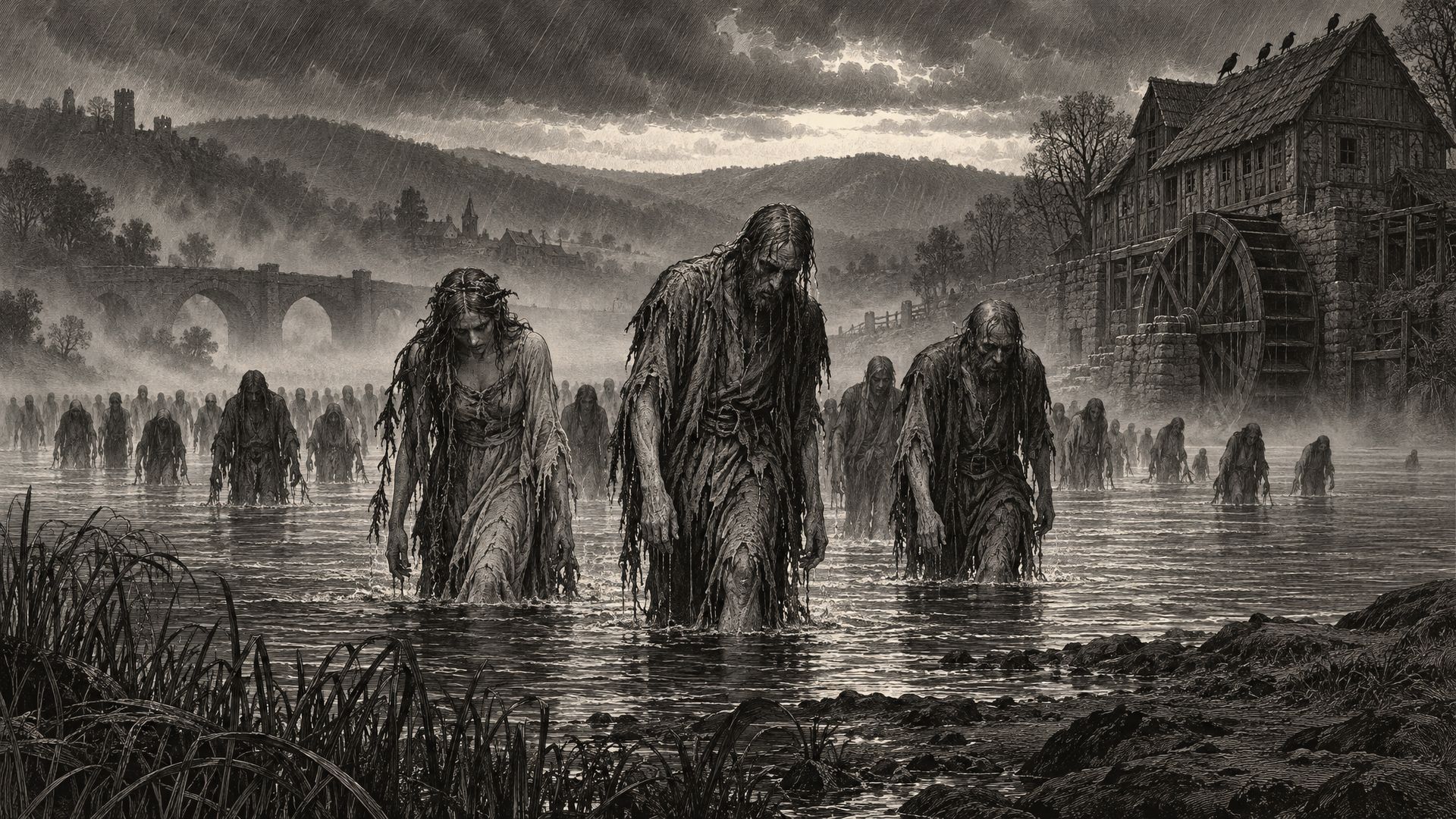
Engraved illustration of the dead rising from a river beside a watermill in The Fallen Age

The Fallen Age

A company marches into the old dark.

Status / PlayablePlay The Fallen Age

Why it exists.

The current playable web build is the second full attempt at an AI-built dark-fantasy strategy/RPG: part model-comparison experiment, part foundation for games set in Rosmer Creative worlds.

Test how far AI can carry a game from research through implementation, while establishing a reusable base for the strategy/RPG hybrids I want to build.

How it got here.

Two complete builds, several toolchains and a practical comparison of what different AI models do well—and where they still struggle.

01 / ORIGIN

A stress test with a game at the end

I had far more GPT-5.6 Sol usage than I was consuming and wanted a genuinely demanding way to test it. The Myth games—especially The Fallen Lords and Soulblighter—offered the right target: atmosphere, tactics and systems that had stayed with me.

The experiment was simple: give the model room to build and see whether it could turn that inspiration into something playable. It could.

02 / FIRST BUILD

Playable arrived before polished

The first prototype worked, but only just. It had no sound, crude 3D models and too little atmosphere. Even so, the core was playable and some of its presentation ideas were already surprisingly effective.

GPT-5.6 Sol also did thoughtful research into the original Myth games: what made them distinctive, how their systems fit together and which design decisions mattered.

03 / TOOLCHAIN

The AI operated the tools

I connected ElevenLabs and let the agent handle the audio work. I did not personally operate the production tools; discovering how effectively an agent could use them was part of the test.

I later took the same approach with Unity. GPT-5.6 Sol rebuilt the game there, producing immediate gains in environmental rendering and unit behavior without requiring me to become the Unity operator.

04 / 3D LIMITS

A mesh is not a game-ready character

The proposed pipeline was to generate meshes in Tripo, rig them and then animate them. The characters could look convincing while standing still, but joints distorted, shields faced the wrong way and movement exposed how fragile the assets really were.

The deeper problem was visual judgment. The agent often accepted obviously wrong motion, then made narrow corrections that introduced new errors. Long correction sessions produced little progress, so I paused the Unity version when I left to travel.

05 / SECOND BUILD

Fable 5 starts clean

A few weeks later I gave Fable 5 the same broad challenge, this time allowing it to choose its own approach instead of prescribing Unity. That rebuild became the current web version of The Fallen Age.

Fable showed better 3D instincts, although it was more literal about the Myth inspiration and less perceptive about why those games worked. Trees, undergrowth, water and environmental physics all needed deliberate rounds of improvement.

06 / FOUNDATION

Mechanics before bespoke assets

For the current build, Adobe Mixamo provides dependable models, rigs and basic animations. The result is more generic, but it avoids repeating the failed character pipeline and creates a stable surface for systems work.

The focus now is movement, vision, hearing, sneaking and detection—the mechanics that can support tailored missions and richer RPG play. Even a vision system exposes new problems, such as units seeing through walls. Solving those interactions is the real experiment, and the eventual destination is a fuller engine such as Unity or Unreal.

How I’m approaching it.

  1. 01

    Give each model meaningful ownership of the implementation, then judge the result as a playable system rather than a coding demonstration.

  2. 02

    Compare complete builds to reveal complementary strengths: research and system reasoning in GPT-5.6 Sol, stronger spatial and 3D instincts in Fable 5.

  3. 03

    Use a dependable Mixamo asset pipeline while the experiment is focused on mechanics rather than bespoke character production.

  4. 04

    Build reusable movement, perception and stealth systems that can later support strategy/RPG games across multiple Rosmer Creative worlds.

Engraved illustration of the dead rising from a river beside a watermill in The Fallen Age
A company marches into the old dark.

Where the idea pushes back.

01

Visual judgment

An agent can manipulate a 3D scene without reliably recognizing a backwards shield, broken pose or correction that creates a new error elsewhere.

02

Character pipelines

Generated meshes may look good at rest yet deform badly when rigged. Mixamo is a useful compromise, but it trades originality for dependable motion.

03

Interacting systems

Water, vegetation, line of sight and detection each look manageable alone; their edge cases appear when they begin affecting one another.

What exists now that didn’t before.

  • A current Fable 5 build that is publicly playable on the web.
  • Two complete model-led approaches tested in practice, including a GPT-5.6 Sol Unity rebuild.
  • An audio pipeline handled by the agent through ElevenLabs.
  • A stable Mixamo-based character and animation foundation.
  • Working movement, vision, hearing, sneaking and detection systems.
  • A clearer reusable base for future strategy/RPG hybrids set in Rosmer Creative worlds.

The living record.

Newest entries belong at the top.

Perception and movement systems

Development is focused on vision, hearing, sneaking, detection and movement—including the edge cases that emerge when those systems meet level geometry.

Fable 5 web rebuild

Fable 5 rebuilt the game from scratch for the web. Environment, vegetation, water and 3D presentation have been iterated from that new base.

GPT-5.6 Sol and the Unity detour

The original browser prototype gained agent-produced audio before being rebuilt in Unity, where the generated-character pipeline became the limiting factor.

A model stress test

The Fallen Age began as a deliberately demanding test of GPT-5.6 Sol, using the atmosphere and tactics of Myth as inspiration for a playable experiment.